Human Factors · Human-AI Interaction · Ethical Design · Concept
Built to calm the fear. Realised the data was the threat, not the answer.
- Role
- Behavioral Researcher & Designer
- Scope
- Deep research · model prototype
- Type
- R&D Human Factors · HAI
- Year
- 2025
- Status
- Concept
38%
feared automation would replace their job within two years
32%
expected AI to leave them with fewer job opportunities in the long run
Pew Research Center, February 2025 ↗
2026 update49% personally afraid of losing their job to AI — Modern Health, April 2026 ↗
22%
strongly agreed their job was safe from elimination
ADP Research, 2025 Global Workforce Survey ↗
FieldworkJuly–August 2025, 39,000 workers across 36 markets — published March 2026 ↗
Being afraid for your job changes how you read. Attention narrows, working memory fills, and the sense that you still get to decide starts to thin. That is the state these three numbers meet you in — and most career tools answer it with more of them.
Mindure is a career guidance dashboard concept for people worried that AI will take their job.
I researched the problem and redesigned an AI-generated draft of its six sections for people under stress.
View prototypeCareer guidance matched to how your mind is wired.
Mindure matches how a person’s mind is naturally wired with the live job market and the skills each role needs, so they can choose work that fits and is harder for AI to replace.
Six sources feed one view: nervous system profiling, real-time economic data, job market updates, upskilling, strategic planning, and wellbeing.
Each section shows only what a person can act on now, and says in plain language where its data comes from.
The design problem was timing: career data arrives exactly when a person is least able to take it in.
Four fields studied; stress set the rules.
Across the four fields, three findings about stress, from human factors research, became constraints the interface had to meet.
Resource links
- The Age of Employment Uncertainty — American Psychological Association →
- Fragmented information & sense-making — Wikipedia →
- Information overload — Wikipedia →
Sweller, J. (1988). Cognitive load theory — working memory has a strict capacity limit. When exceeded, processing stops entirely.
Easterbrook, J.A. (1959). Threat signals narrow attention to immediate danger, away from strategic thinking.
Bhorat, Z. (2023). Automation Anxiety and a Right to Freedom from Automated Systems and AI. Carr Center for Human Rights Policy, Harvard Kennedy School. Automated systems that score and decide on behalf of users threaten three core human abilities: to work, to understand information, and to make autonomous decisions. carrcenter.hks.harvard.edu
Three findings about stress became rules.
Each one rules something out. If attention narrows under threat, urgency cannot be used to prompt action. If load has a ceiling, completeness stops being a virtue at the point the ceiling is reached. If automated judgement erodes autonomy, a score is a verdict dressed up as an insight.
Together, they decided more of this interface than any of my preferences did.
What does stress do to how people take in information?
Anxiety narrows attention
Under threat, the brain processes less.
Cognitive load has a hard ceiling
Go past it and the brain shuts down.
Automation anxiety erodes autonomy
It erodes the ability to make your own decisions.
Career signals overflow one person’s capacity.
Career anxiety doesn’t come from a lack of motivation. It comes when an unstable market, a person’s limited capacity and high-stakes decisions all meet, and the person can no longer make sense of it.
When signals don’t connect, users face stress and uncertainty.
In the drawing below, each dot is a signal arriving. The box is what one person can hold and act on at once, and it is already full. That much volume outside it is normal. What fails is the assumption that someone will sort it.
Why are even capable people struggling right now?
Why don’t career signals add up?
Market signals
Economic signals
Personal signals
Planning signals
How much can one person hold at once?
- Planning pressure
- Personal capacity
- Economy & automation
- Market & skills
Dots inside → manageable loadDots outside → overload
It shows only what you can act on now.
Macroeconomic signals, skills-gap mapping and stress-state detection feed a single output layer.
Six sources, each with limits.
Every section also tells users where its data comes from, in plain language, at the moment they need it. It sits on the screen itself.
Each section has a job and a line it must not cross: Market and economy gives context but never urgency, and Career actions shows options but never tells the user what to do.
How might six sources speak with one voice?
Where does each section have to stop?
| Section | Responsible for | Not responsible for |
|---|---|---|
| Overview | Immediate orientation | Predicting outcomes |
| Personal Insights | Describing thinking patterns | Scoring or ranking the user |
| Career Actions | Surfacing options with reasoning | Telling the user what to do |
| Market & Economy | Context for decisions | Triggering urgency or fear |
| Skills Builder | Learning tied to your profile | Imposing a fixed sequence |
| Strategic Planning | Quarterly direction | Daily commands or schedules |
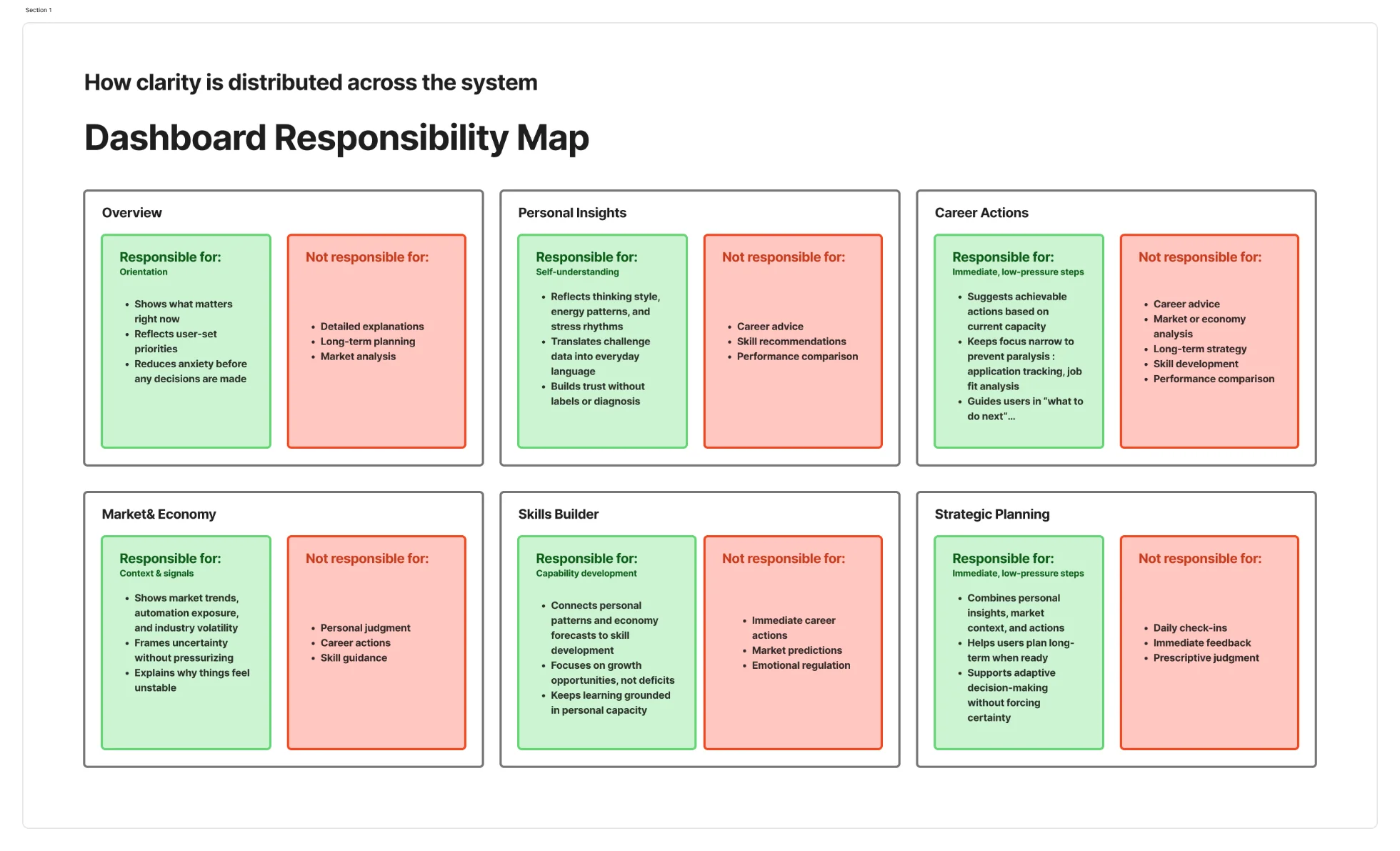
Redesigned the AI draft for anxious minds.
Each redesign traces back to a human state.
One place to start.
Ten scored modules became five cards, with one thing to look at first.
Overview: where do I start?
Read the observations and decisions below
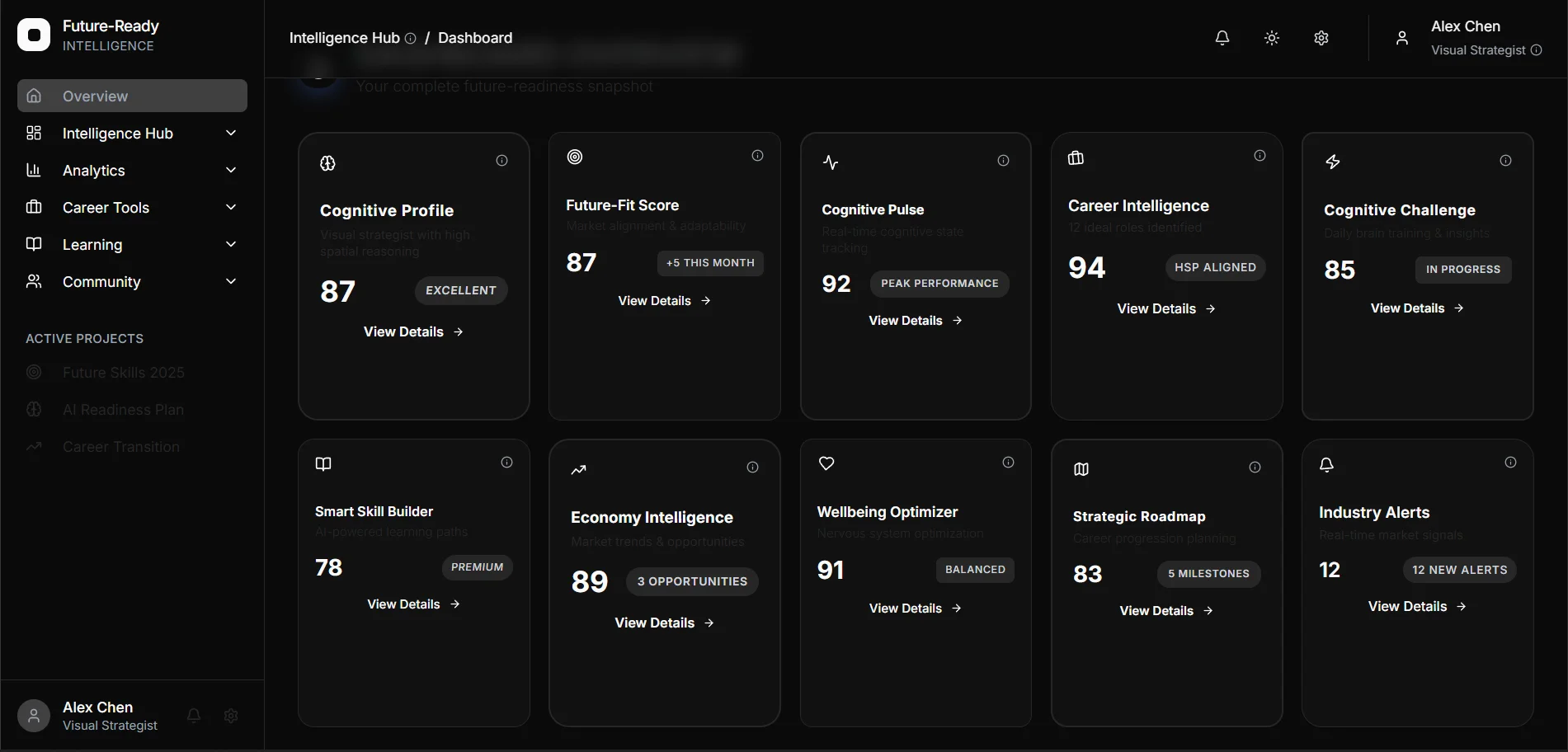 Raw AI output
Human-in-the-loop
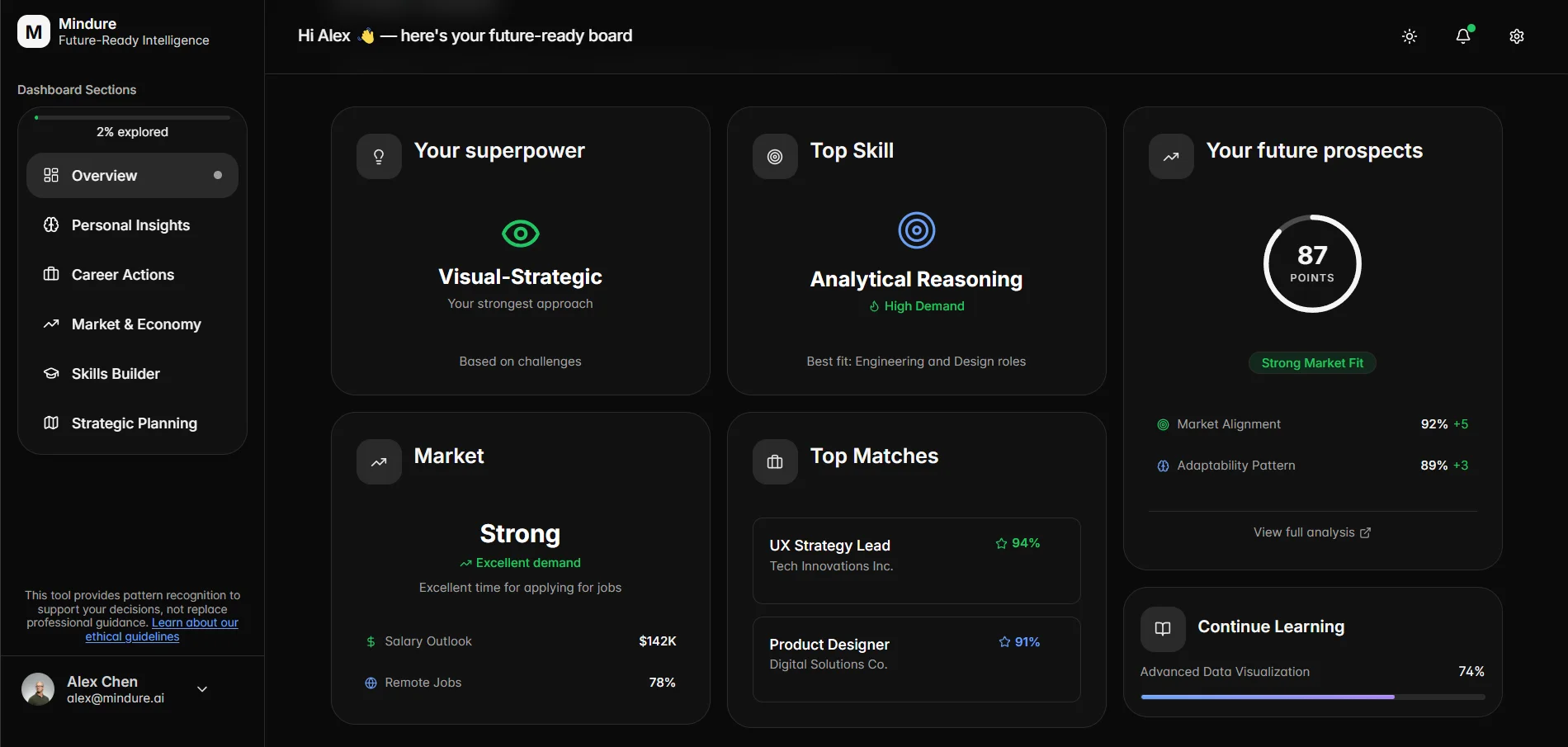
Raw AI output
- 10 scored modules displayed simultaneously. No visual hierarchy, no entry point.
- With no single place to start, the brain can’t begin, so it freezes.
Decision paralysisCognitive load
Human-centered redesign
- Five cards, with one thing to look at first.
- Because there is one way in, there is less decision paralysis. Volatile data stays hidden until the user is ready for it.
Progressive disclosureSingle entry point
Strengths in plain words.
Percentage scores on inner traits became plain-language strengths, compared only with the person’s own history.
Personal insights: who decides who I am?
Read the observations and decisions below
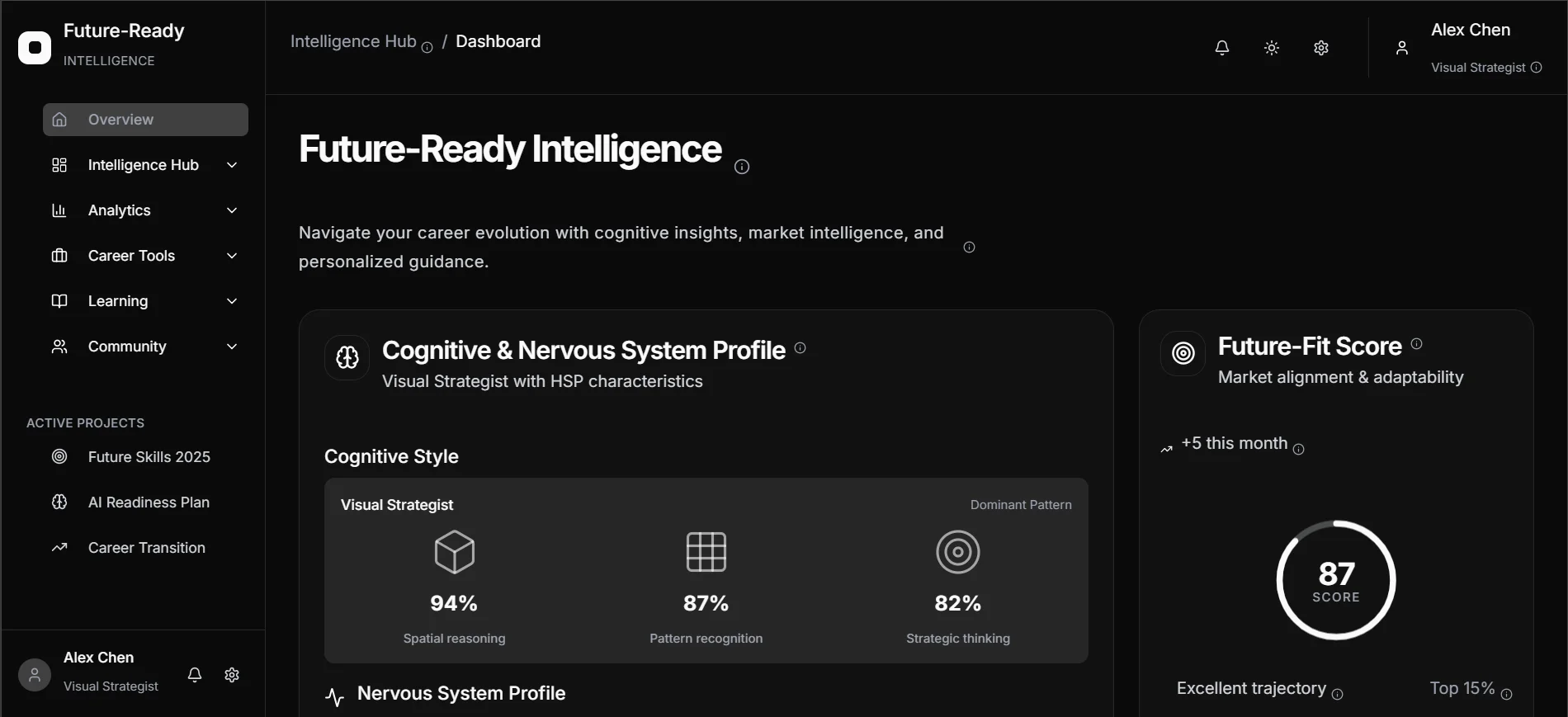 Raw AI output
Human-in-the-loop
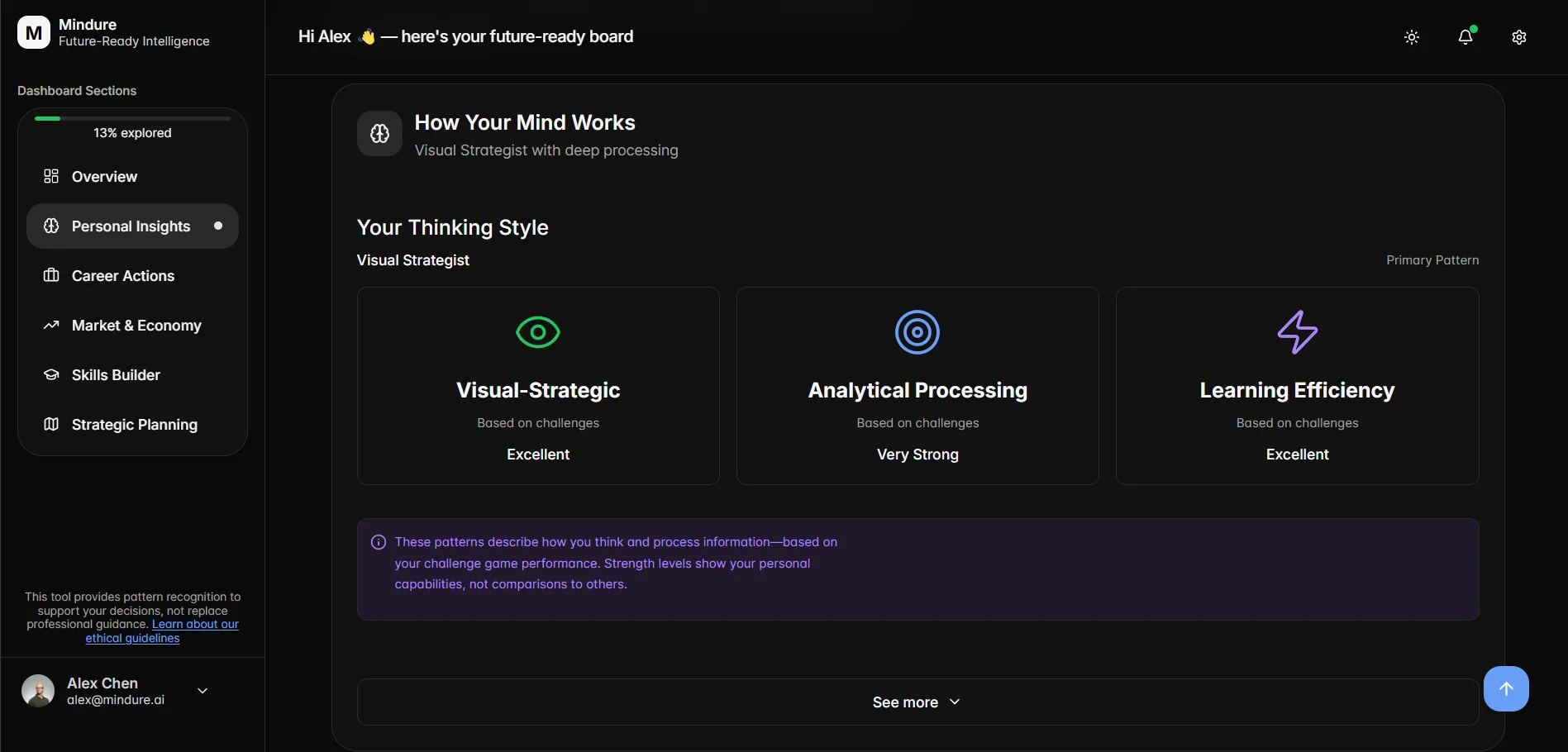
Raw AI output
- Percentage scores on cognitive traits: 94% spatial reasoning, 87% pattern recognition.
- When a system scores someone’s inner traits, they start to doubt their own sense of who they are.
Social comparisonAutomated scoring
Human-centered redesign
- “How your mind works”: strengths in plain language, compared only with your own history.
- Because you are compared only with your own past, there is nobody to compete with.
Self-referential framingPlain language
Options with their reasons.
A schedule of commands became live job options that show their reasoning, so the decision stays with the user.
Career actions: who decides what I do?
Read the observations and decisions below
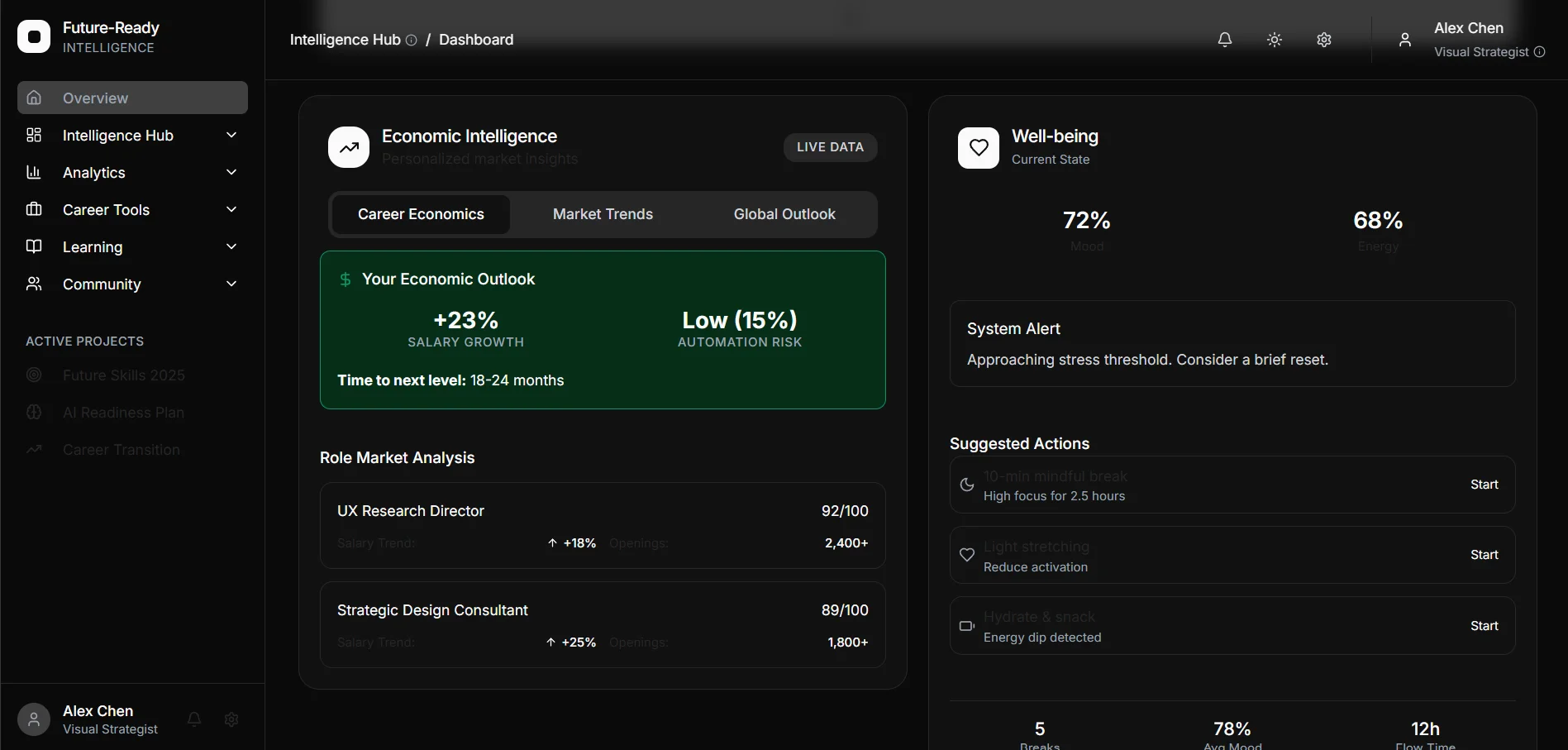 Raw AI output
Human-in-the-loop
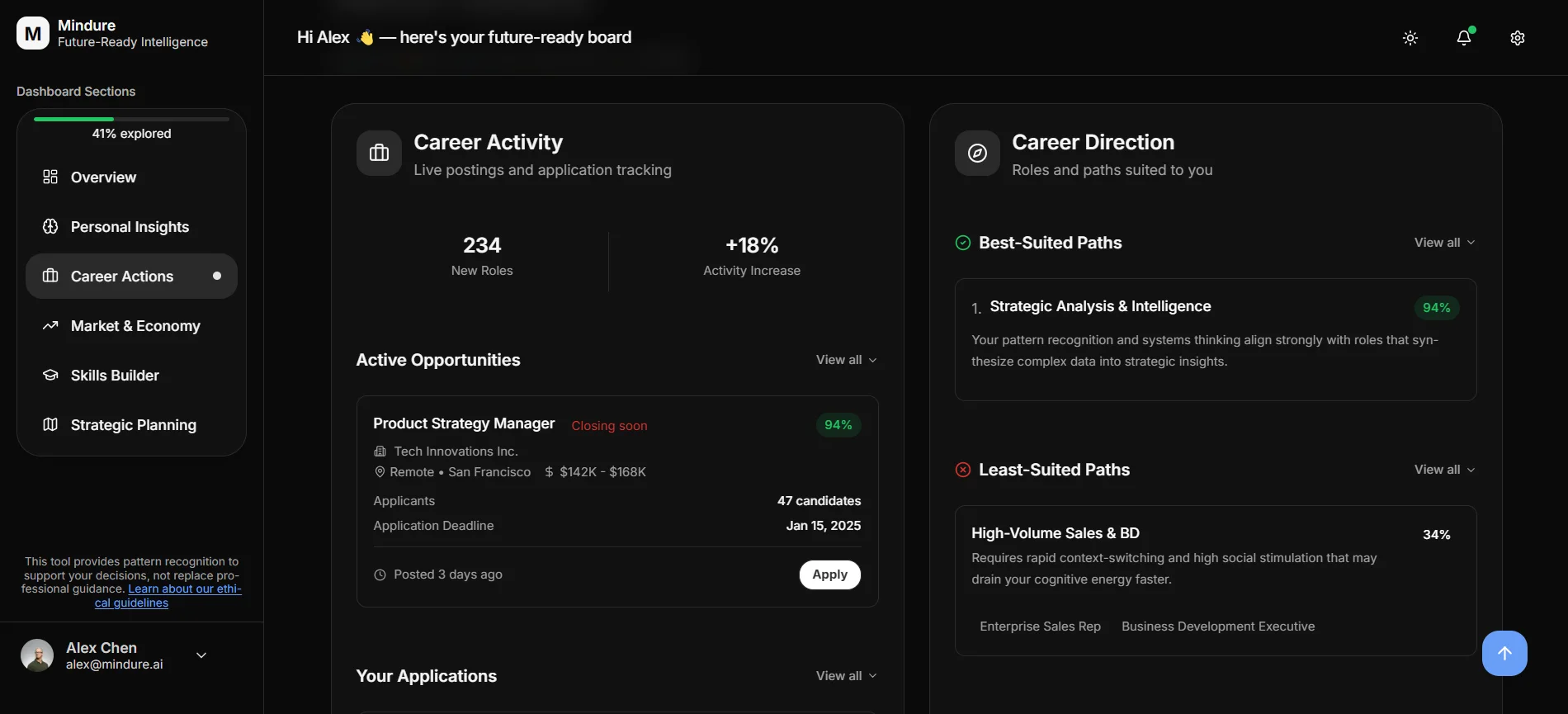
Raw AI output
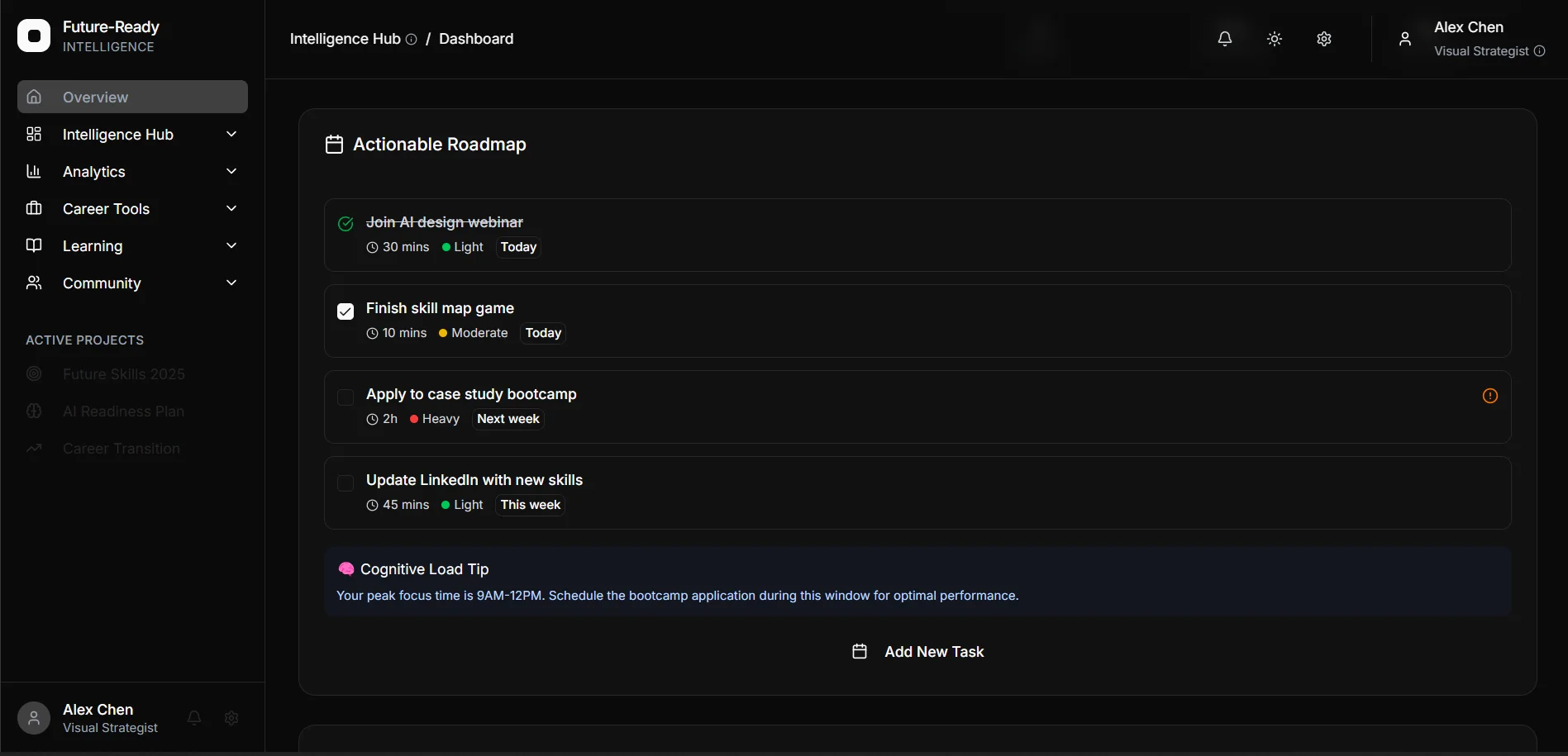
- Actionable roadmap with exact task times, effort labels, deadlines, and a cognitive load tip telling you when to work.
- Commands take away the sense of control, and that sense of control is what most shapes how anxious a person feels.
Prescriptive automationLoss of perceived control
Human-centered redesign
- Live job postings that show their reasoning (“why it fits your thinking style”), with an ethical boundary that stays in the sidebar.
- The system shows options and its reasons, so the decision stays with the user.
Perceived controlVisible reasoningEthical boundary
Market data as calm context.
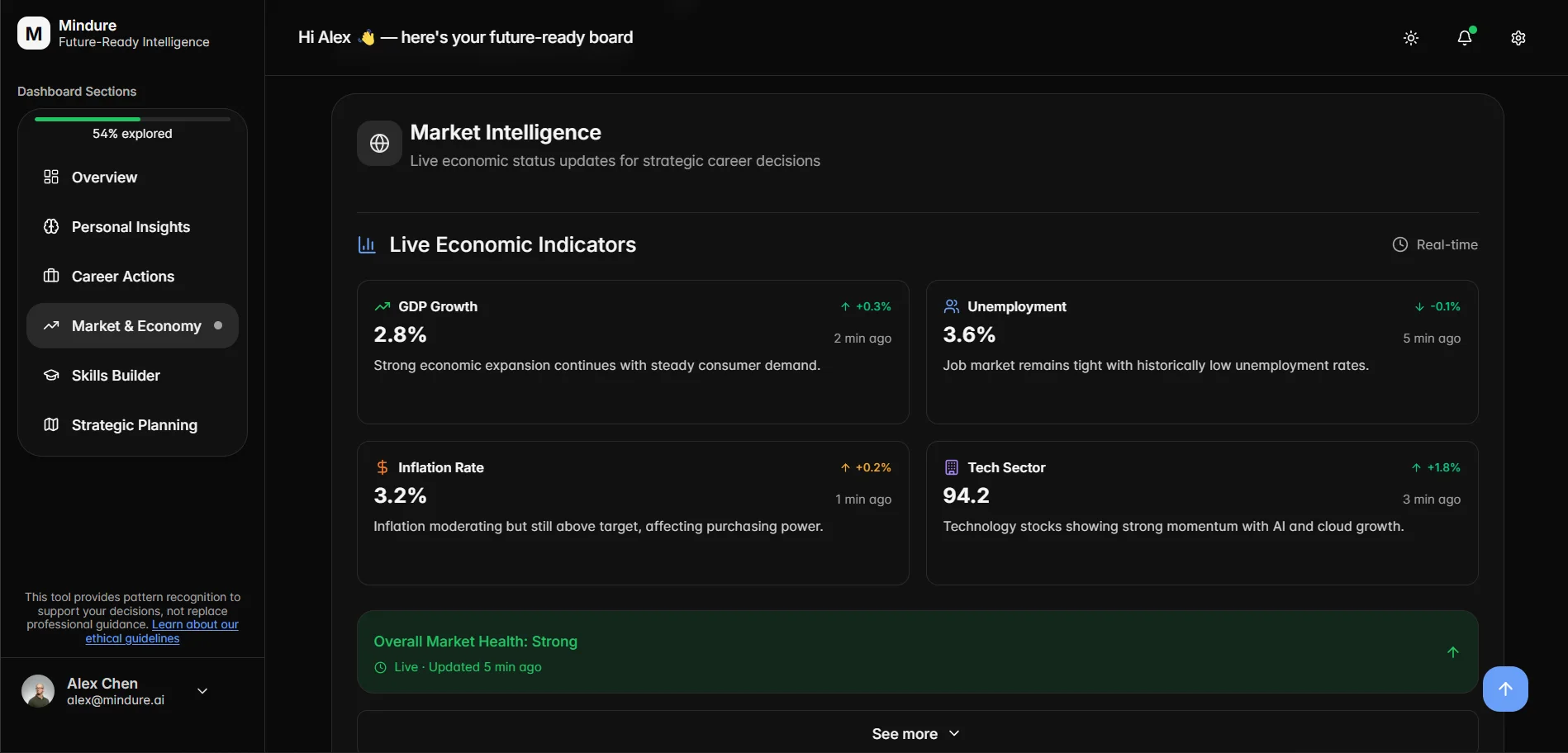
A live ticker stamped “2 min ago” became stable background that the user opens when they choose.
Market and economy: is this urgent?
Read the observations and decisions below
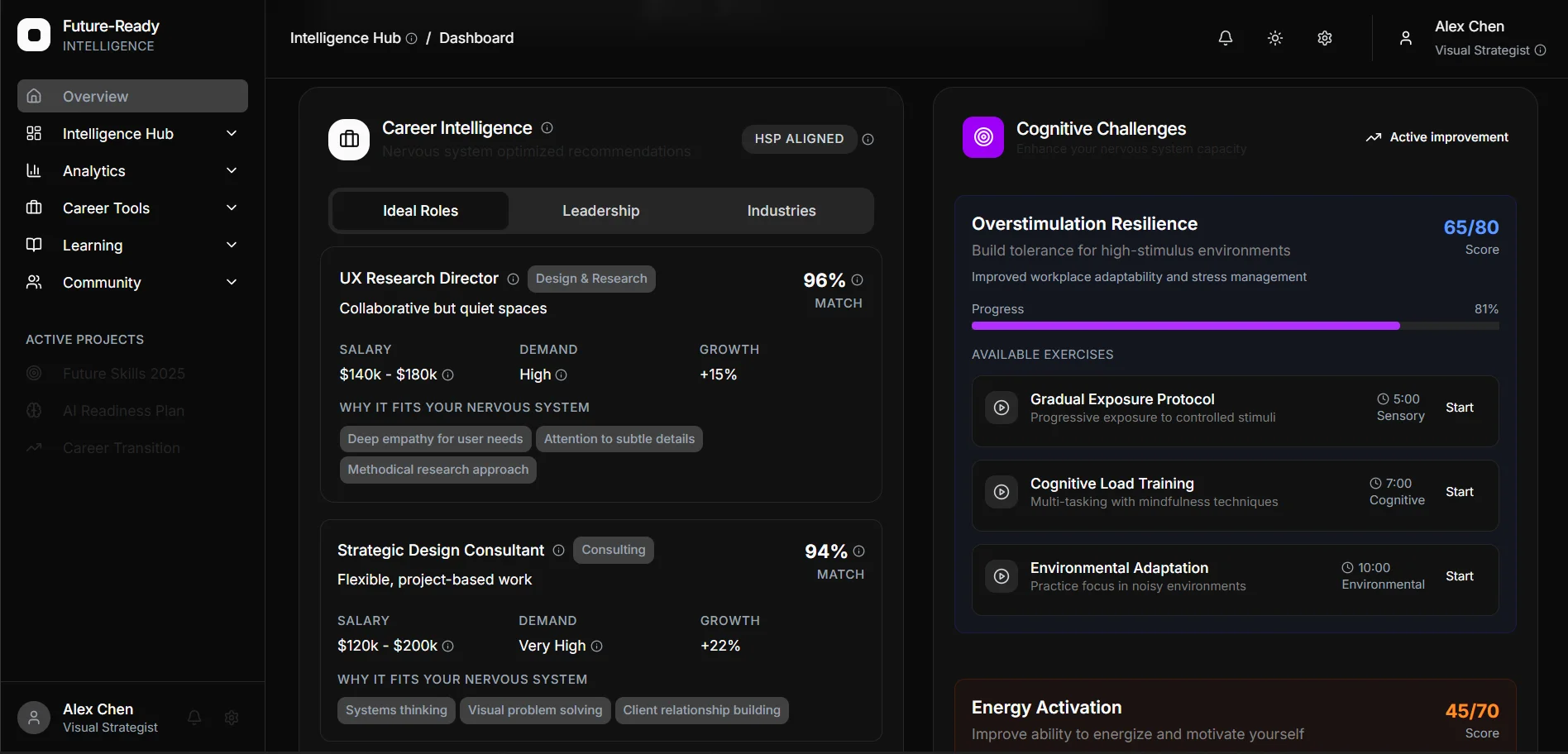 Raw AI output
Human-in-the-loop
Raw AI output
- Live economic indicators (GDP, unemployment, inflation, the tech sector), all updating in real time and stamped “2 min ago.”
- A live ticker reads as a threat, and a threat pulls attention away from planning and toward scanning for danger.
Threat attentionManufactured urgency
Human-centered redesign
- Market Intelligence: the same data, framed as calm background for decisions.
- Because the data is framed as stable context, the user decides when to look at it, and nothing pulls them in.
Context framingUser-initiated engagement
A learning path that fits.
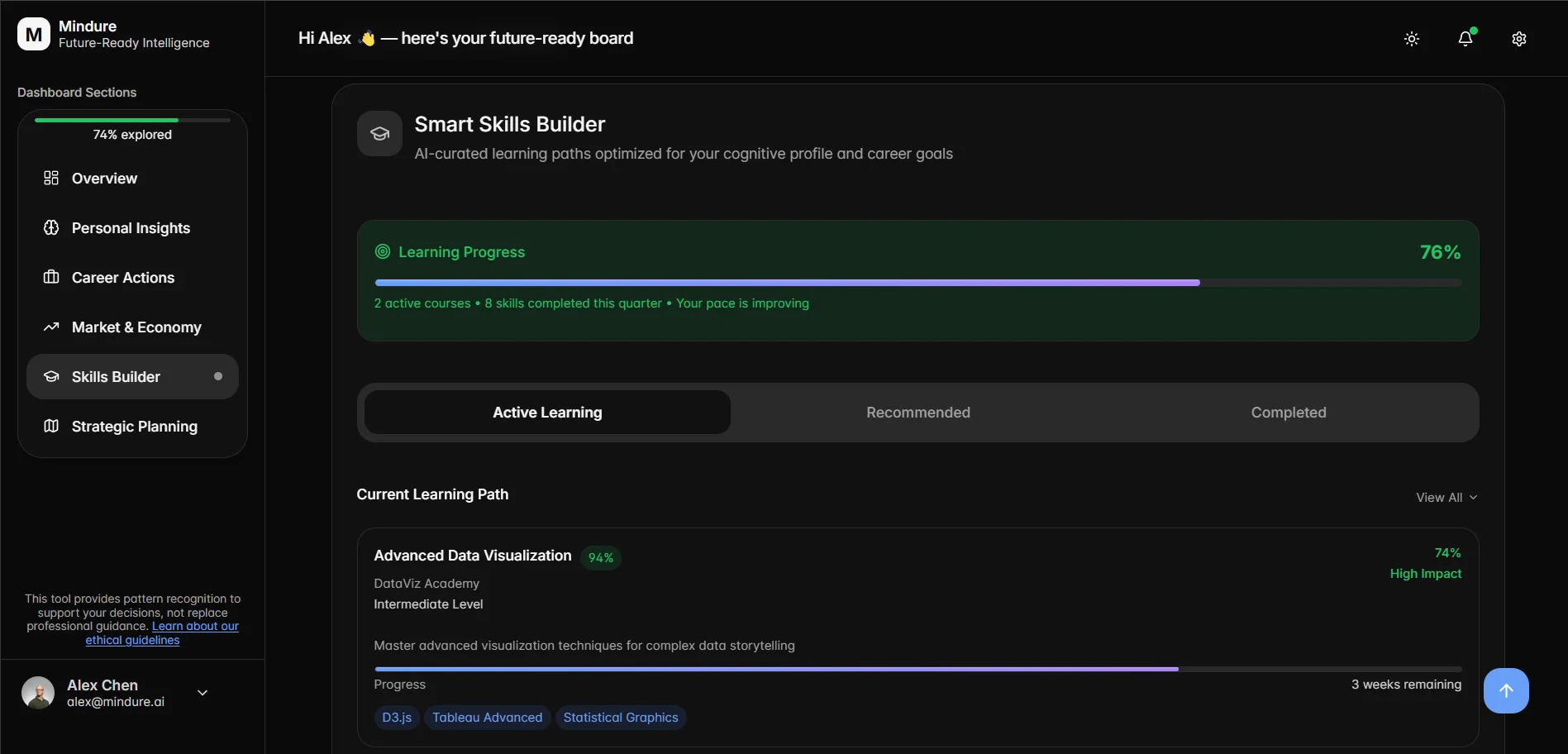
A fixed sequence became a path tied to the person’s profile and direction, with its reasoning visible.
Skills builder: who sets the order?
Read the observations and decisions below
 Raw AI output
Human-in-the-loop
Raw AI output
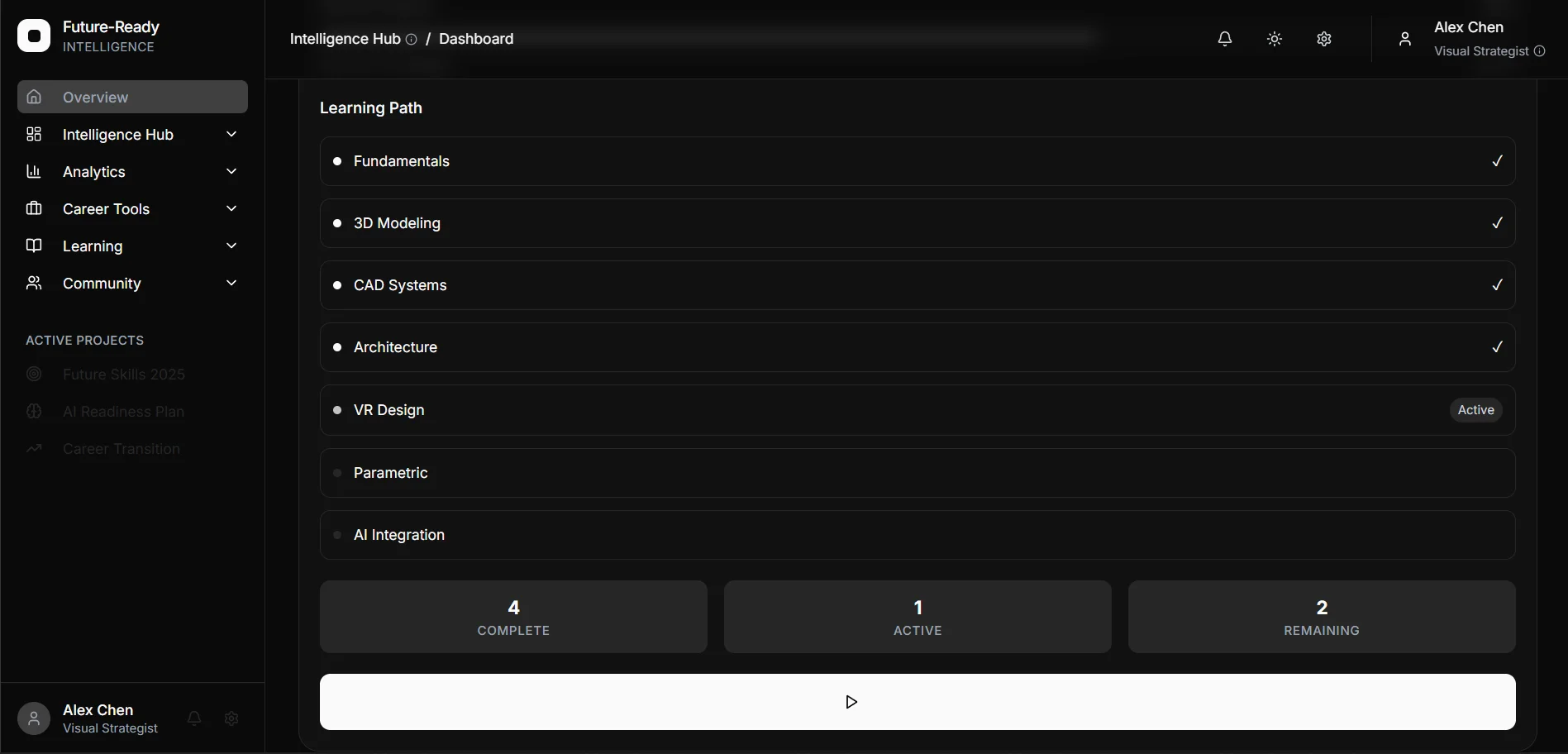
- Linear learning path with a fixed sequence and no reasoning visible.
- A fixed order undermines both competence and autonomy, and people need both to stay motivated while learning.
Imposed sequenceAutonomy loss
Human-centered redesign
- Smart Skills Builder: learning tied to your cognitive profile and career direction, with the reasoning visible and progress measured against your own goals.
- Because the path follows who you are, the order is yours, and progress is measured against your own goals.
Competence and autonomySelf-referential progress
Plans by the quarter.
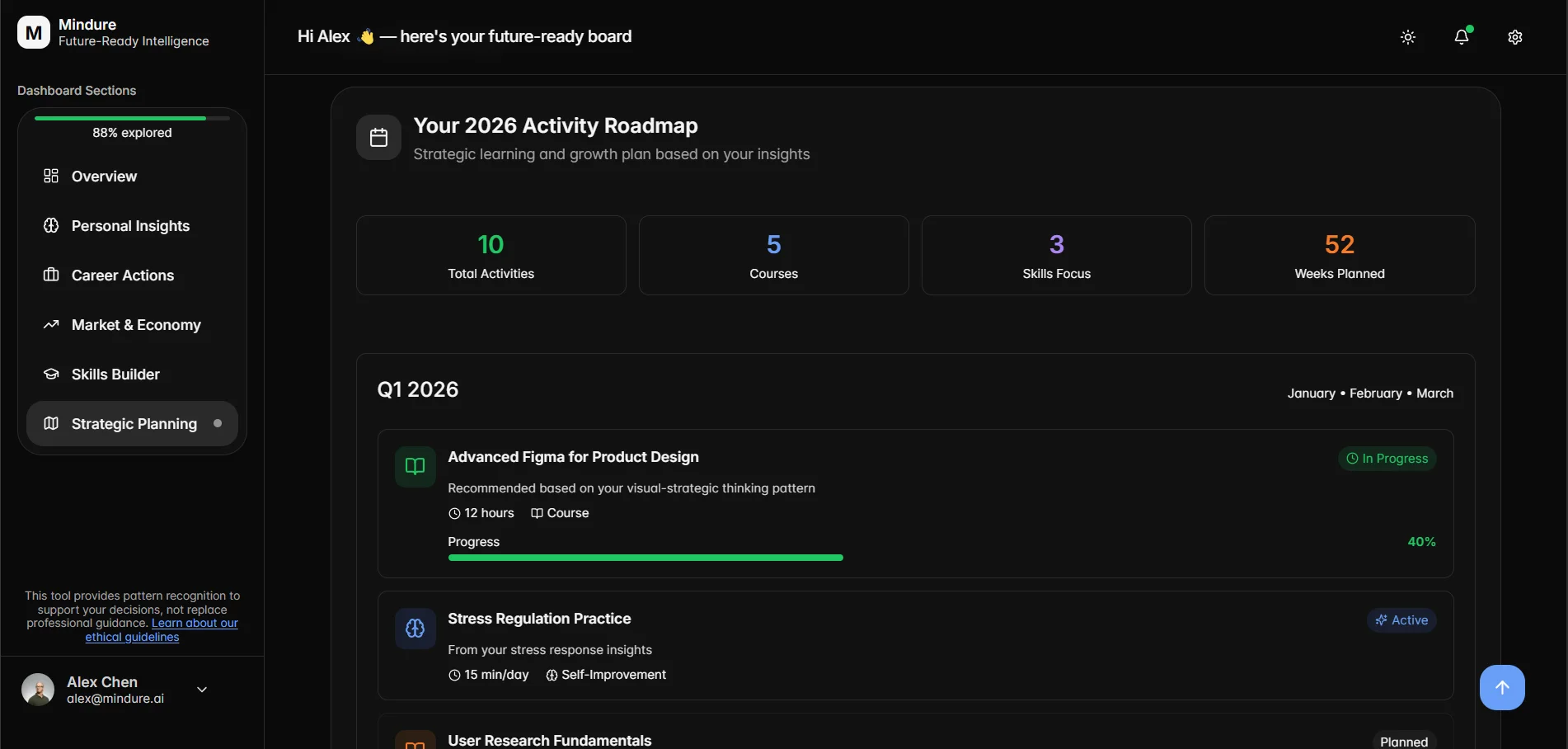
An hour-by-hour calendar became quarterly blocks, with stress-regulation practice next to the courses.
Strategic planning: how far ahead helps?
Read the observations and decisions below
 Raw AI output
Human-in-the-loop
Raw AI output
- A daily calendar with exact time blocks, where the algorithm sets the schedule hour by hour.
- Rigid plans increase anxiety when disrupted. Certainty that breaks is worse than no certainty at all.
Over-specificationBrittle certainty
Human-centered redesign
- 2026 Activity Roadmap: quarterly blocks, loosely framed, with stress-regulation practice next to the courses.
- Planning by the quarter gives a direction without fixing every step, so the person gets long-term clarity without short-term pressure.
Coarse time granularityStress regulation
Less on screen, more a person can act on.
For someone already overwhelmed, showing everything works against clarity. The fix is a different idea of what the system is for.
Next time: start with stress research.
I designed the calm state first and worked backwards. Next time the anxious state becomes the main design surface.
“A system that gives you everything it knows is not a helpful system. Helpfulness is knowing what to withhold, and when.”